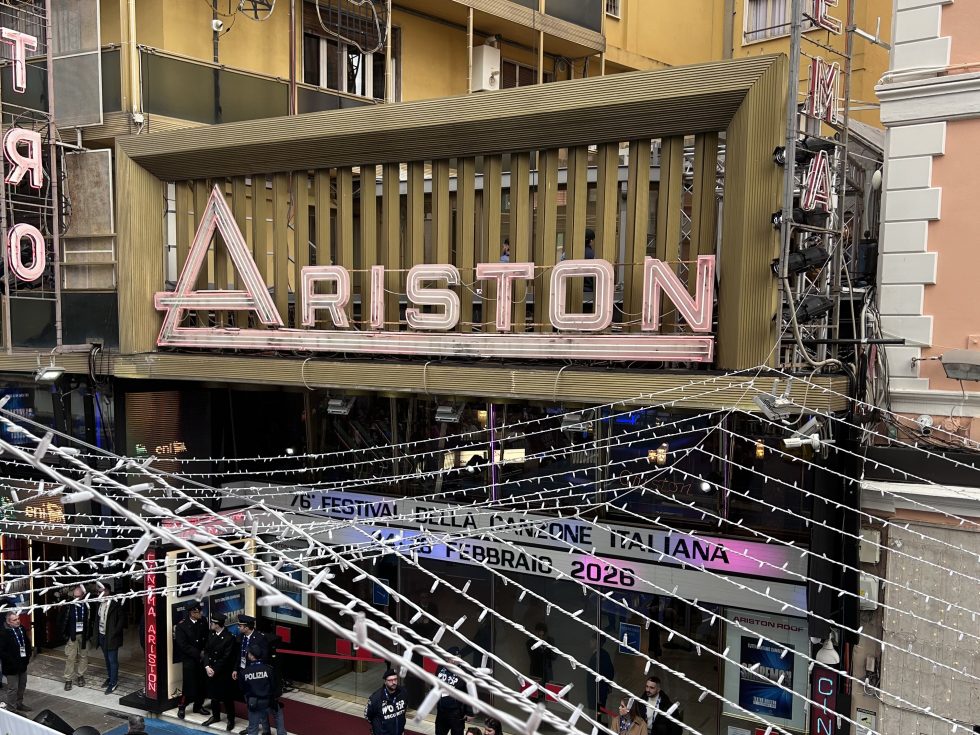
Cover photo: Ariston Theatre. Source: Mediatrends
The original version of this article was published in Italian by the same author on 2 March 2026.
The Sanremo Festival that has just wrapped up once again confirmed its central place within the Italian media system.
It was not a flop, but neither was it a resounding triumph. It was an industry success, yet it failed to build a truly compelling story around itself.
But let’s start with the numbers.
Sanremo 2026: the figures
Auditel data shows that just under 10 million viewers watched the five nights on average, with a 62.5% audience share.
The drop in headcount compared with last year is undeniable. For example, at 2:13 a.m. on the night between Saturday and Sunday, when the winner was announced, Rai1 had 7 million viewers — almost two million fewer than in 2025. This decline can be explained by a series of technical factors.
First of all, the competitive landscape had changed. Suffice it to think of Wheel of Fortune, which aired regularly throughout the week in Canale 5’s access prime-time slot, and of the decisive Champions League matches involving Inter and Juventus. Juventus’ match in particular was exclusive to Prime Video, a platform not measured by Auditel.
In addition, the overall television audience has shrunk. In this respect, the postponement of the Festival’s broadcast from early February to the end of the month – because of the overlap with the Milan-Cortina Winter Olympics – was a crucial factor.
One figure that is likely to spark interesting debate in the near future is the decline in on-demand viewing – for example on RaiPlay, which is tracked by Auditel – in favour of social-media consumption, which is not monitored by the company that measures television audiences.
In short, users increasingly prefer the immediate, frictionless viewing of content on a social platform they are already logged into, rather than making the “effort” of a double click that takes them elsewhere. So how can all of this be monetised? That is a good question – and like many good questions, it has no answer.
When it comes to social media, the most striking figures are 1.2 billion total views – 33% of them generated by Rai accounts – and 150 million interactions, 30% of them again generated by the public broadcaster’s accounts. According to Elena Capparelli, Director of RaiPlay and Digital, those numbers made Sanremo 2026 the most commented-on event in the world after the Super Bowl.
According to the official figures released by Rai Pubblicità, advertising revenue reached €72 million, an increase of more than 10% on last year. It is a staggering amount, one that once again confirms Sanremo as a profitable phenomenon unlike anything else in the Italian entertainment industry.
From a strictly musical point of view, leaving aside subjective judgments – the overall standard still seemed fairly low – the most worrying trend is this: for the first time in the past five years, none of the competing songs exceeded one million streams on Spotify Italy on the day after their debut.
Carlo Conti’s television
Sanremo 2026 was a stifling mix of traditionalism and paternalism, with an overall numbing effect.
This is Carlo Conti’s television: the quintessential average man, one who watered down every kind of controversy with almost impeccable communication marked by ostentatious serenity and wisdom. The strongest controversy – the one involving comedian Pucci – had already erupted before the Festival went on air; after that, we had to make do with the “golden mummy” remark aimed at Olympic champion Francesca Lollobrigida. Conti’s hosting was rhythmic and elegant, yet devoid of artistic spark and, at times, it even seemed almost resigned.
One of Conti’s very rare missteps came during the final, while on our screens the endless social-media scroll around Sanremo was being interrupted by frightening images of Dubai airport hit by drones and by Big Mama’s video appeal.
At one point, the Festival’s dominus, addressing his wife Francesca Vaccaro, seated in the front row, made a joke about the very ripped, skin-tight jeans worn by one of the dancers on stage: “Listen, my dear little wife, since I know you like jeans, don’t buy the model that young lady was wearing, all right? Thanks. It’s pure jealousy!”
A few minutes later, Gino Cecchettin – the father of Giulia, the 22-year-old murdered by her ex-boyfriend Filippo Turetta in November 2023 – took the stage, and his words created a chilling short circuit: “Violence against women begins much earlier than we think. It begins when we mistake control for love, when we think jealousy is necessary in a relationship, when we fail to teach respect, when we let those jokes – those sexist jokes – pass in silence, when we use violence in our words. And if we focus only on the final act, we lose sight of everything that comes before.”
In an event during which practically nothing happened, family functioned as a kind of common thread: the mothers of Sayf and Samurai Jay on stage; Serena Brancale, directed by her sister, singing for her late mother while wearing one of her dresses; Tredici Pietro performing a duet with his father Gianni Morandi; and Gianluca Gazzoli moved to tears on the day that coincided with the birthday of his late mother.
In Search of Censorship
The case of the alleged – but nonexistent – censorship of the kiss between Levante and Gaia during Friday night’s covers show is emblematic. There was never any censorship, yet the very fact that the idea seemed plausible says not only a great deal about the impatience of a certain hasty social-media debate, but above all about the low level of public trust in Rai — a broadcaster from which, to put it bluntly, people feel they can expect just about anything.
After all, this is the same public company that concealed Ghali by never mentioning him during the disastrous commentary of the Milan-Cortina opening ceremony – an initiative taken by the now former RaiSport director Petrecca, not by some random passer-by.
The Festival, inaugurated on the eve of the event at the Quirinale by President of the Republic Sergio Mattarella and won, in grassroots fashion, by Sal Vinci, offers the image of an Italy still grappling with its eternal dualisms: Naples versus the rest of the world, televoting versus the press room, virality versus quality.
Stefano De Martino, the Newcomer on the Rise
A historic moment came with the passing of the baton between hosts and artistic directors, staged in the stalls of the Ariston Theatre.
From Carlo Conti to Stefano De Martino; from old to young; from the long-established radio man and reliable television figure to a personality who owes much of his popularity to gossip; from the safe pair of hands to the rising newcomer.
A newcomer advancing quickly – and under protection. Protected first and foremost by Rai, which invested in him a year and a half ago, tying him down with a multi-million-euro contract that included an option for the Festival. And protected by his team: the Neapolitan presenter belongs to Beppe Caschetto’s talent stable, the most important agency in the country alongside Lucio Presta’s Arcobaleno Tre, and he will most likely be supported by an artistic team led by music director Fabrizio Ferraguzzo.
De Martino’s appointment predictably triggered an immediate polarising effect, to the detriment – at least in part – of the competition itself.
The first skirmishes between the press and the public broadcaster over meritocracy and musical expertise, together with references to past rumours about his alleged friendship with Arianna Meloni – denied by both sides – are the price Rai has decided to pay in order to launch, well in advance, the narrative that will need to accompany and substantiate the former Amici dancer in his Sanremo adventure.
For the first time in the past ten years, it will not be the host who strengthens Sanremo, but Sanremo that legitimises its new helmsman. And that may not necessarily be a drawback for viewers.