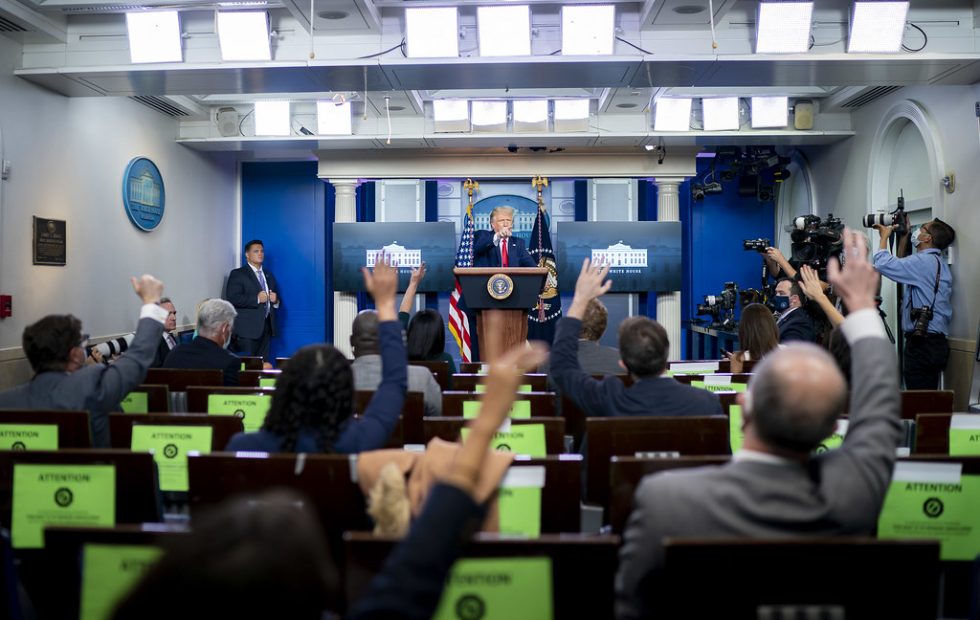
Cover photo: White House Press Briefing. Source: Flickr
The original version of this article was published in Italian by the same author on 9 February 2026.
With the evolution of social media, influencers have become a constant presence in the coverage of American politics, commenting on election campaigns and building narratives alternative to those of traditional media.
Over the past twelve months, however, this role has undergone a deeper transformation: influencers no longer simply report on politics; they have become an integral part of it.
Access to the White House, the press room, and informal briefings signals a form of legitimacy that goes beyond communication.
Commentators and creators are no longer treated as external observers, but as fully legitimate political interlocutors.
This signals a structural change in how power is narrated, and, above all, how it is measured and constructed.
From Narrative to Power
An emblematic example of this shift is embodied by Trump ally Alex Bruesewitz.
As reported by Axios, during the Republican primaries, Bruesewitz played a central role in strengthening Donald Trump’s digital presence and limiting the visibility of his main internal rivals.
His value lay less in the content itself and more in his ability to expand and steer an already politically aligned audience.
After the elections, his company, X Strategies LLC, now manages digital communications for the Republican PAC Never Surrender.
This transition clearly shows how managing online communities has evolved into structured political influence.
A similar evolution concerns former campaign manager Brad Parscale.
According to Axios, in September 2025, he signed an agreement to influence the American debate on Israel through targeted social media campaigns aimed at Generation Z.
Here, the influencer does not simply support a candidate: he helps shape public perception of a foreign policy issue.

Brad Parscale. Source: Flickr
Influencers as Instruments of Soft Power
The Parscale case is not unique in media pressure strategies adopted by foreign nations, which invest in influencers to steer debate in the United States.
Beginning in spring 2025, China used content creators and social media personalities as soft power tools, seeking to normalise its image among Western audiences.
Qatar has recently adopted a similar strategy.
As reported by the Washington Times, the country has progressively supplemented traditional lobbying operations with trips and experiences offered to online figures, aiming to improve its influence in the United States.
During the Formula One Grand Prix in Doha, the Qatari government invited selected creators and influencers into the paddocks, allowing them to cover the event firsthand while simultaneously building informal relationships with domestic and foreign state officials.
Diplomacy thus moves from institutional corridors to social media feeds.
The Decline of K Street and the Rise of New Lobbyists
This transformation is also visible in Washington.
As analysed by the Wall Street Journal, traditional lobbying is going through a period of contraction.
Companies and pressure groups are relying less on recognisable K Street professionals and increasingly on hybrid figures: activists, online commentators, creators with established communities.
According to Wired, the new lobbyist is not necessarily a declared actor. They may be a niche influencer, an active member of a digital community, or a socially integrated public figure.
Their strength lies in credibility and in the ability to frame a political message as a personal experience rather than organised pressure.
The key point is that these new actors occupy a space that was once divided.
They explain politics to the public, as journalists would do. They influence agendas and priorities, like lobbyists. They help a cause or candidate build consensus, like political consultants.
Between Regulation and Morality
The issue is not any single function, but the undeclared overlap.
As observed by the Centre for Democracy & Technology, much politically relevant content on social media does not formally fall under the category of advertising, even though it produces effects similar to those of a structured campaign.
Regulation continues to focus on the form of the message, not its context and impact.
Republican journalist Ben Shapiro has also addressed this point.
According to the founder of The Daily Wire, political free speech only makes sense if what is expressed is authentic.
If content is paid, coordinated, or incentivised, the public should know. Otherwise, personal opinion and strategic persuasion become indistinguishable.
This is not just a regulatory issue, but a matter of moral responsibility.
In an ecosystem that rewards engagement and emotional intensity, ambiguity becomes a political resource. And it is precisely this ambivalence that makes influencers more effective than traditional lobbyists.

Ben Shapiro. Source: Wikimedia Commons
Democrats Try to Catch Up
In recent months, Democrats have also moved in this direction, increasing influencer access to institutional spaces and experimenting with new programs to strengthen progressive presence in new media.
After the defeat in the 2024 presidential election, the urgency of closing the communication gap became clear.
As reported by Wired, initiatives such as the Chorus Creator Incubator aim to create a new generation of politically aligned creators by connecting them with politicians and officials.
However, these efforts also highlight contradictions within the Democratic camp: greater editorial control, stricter contractual constraints, and a more opaque management of the relationship between content and funding.
The result is a less fluid and less credible ecosystem compared to the conservative one.
While the MAGA world has integrated creators as political actors, Democrats still seem to treat them as communication tools to be managed and disciplined.
Mimetic Lobbying
The comparison between the conservative and Democratic ecosystems highlights a central fact: political influence no longer flows solely through traditional channels, but through the credible occupation of digital communication spaces.
In this context, traditional lobbyists struggle to maintain their centrality, while new figures emerge who can move between storytelling, persuasion, and political support.
These new actors do not replace lobbying; they transform it.
They narrate politics to the public, shape debate, and contribute to building consensus, often without being perceived as representatives of specific interests.
It is this ambivalence that makes them particularly effective, especially in a media system that rewards authenticity and proximity.
The issue today is not whether influencers should participate in politics.
The real question is recognising that a growing share of influence operates in forms that escape traditional categories.
As long as we continue to interpret these phenomena merely as communication, a significant part of political power will continue to move outside our field of vision.